A Tree Fell on the House: Who Pays for Damage and Removal?
Last reviewed November 6, 2026. Free public guidance from The New Faith Church and Co-op, Inc. (NFCcop), a 501(c)(3) nonprofit. This is general information, not legal, medical, or professional advice. Rules can change, so confirm with the official sources below.
When a large tree or heavy limb crashes onto your roof during a storm, the general rule surprises most homeowners: your own homeowners insurance policy pays for the repairs, regardless of whose yard the tree was rooted in. Unless you can prove your neighbor was legally negligent, you must file through your own insurer, pay your deductible, and seek coverage for structural repairs and tree removal.
The Basic Rule: Where the Tree Lands Determines Coverage
Many homeowners believe that if a tree originated on a neighbor's property, the neighbor or their insurance company is automatically required to cover the damage. Under standard American property law, that is not how it works.
When wind, tornadoes, or severe thunderstorms knock down a living tree, insurance companies consider it an "act of God" or weather-related incident. Therefore, the owner of the property that was damaged files the claim under their own policy. If your neighbor's tree falls on your garage, you call your insurer; if your tree falls on your neighbor's roof, they call theirs.
The One Major Exception: Negligence
There is one key exception where a neighbor’s insurance might be held financially responsible: proven negligence.
- Visible decay: If the tree was dead, visibly rotted, or leaning dangerously before the storm, the property owner had a legal responsibility to remove the hazard.
- Written prior notice: If you warned your neighbor in writing (such as a certified letter or arborist inspection report) before the storm and they refused to fix it, their insurance carrier may be forced to pay under liability coverage.
- Subrogation: If you believe your neighbor was negligent, inform your insurance company. Your carrier may pay your claim first and then pursue your neighbor's insurer through a legal process called subrogation to recover your deductible.
Does Insurance Pay to Remove the Fallen Tree?
Whether your homeowners policy pays to haul the trunk and branches away depends entirely on where the tree ended up:
When Tree Removal Is Covered
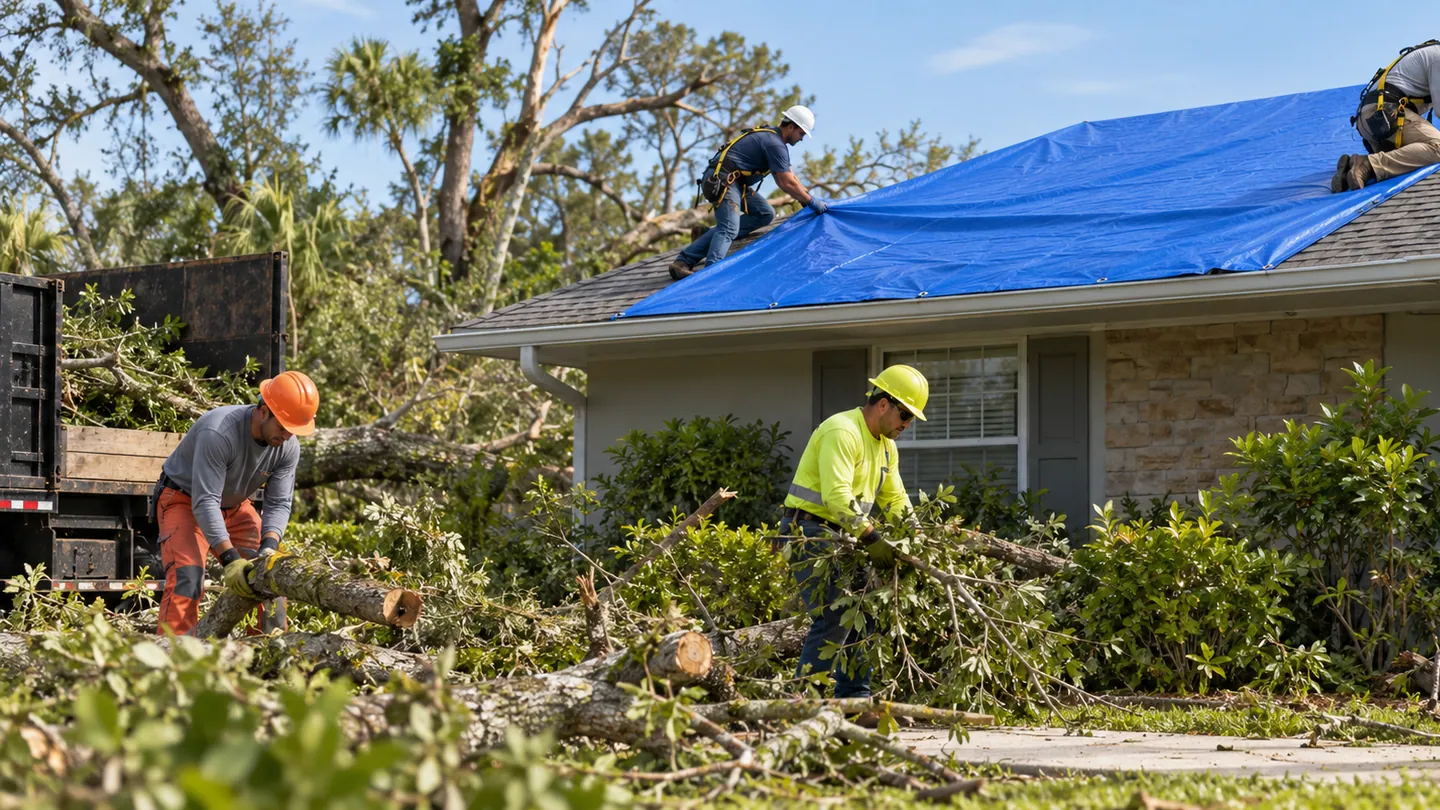
If the tree hits your house, carport, tool shed, or fence, your policy usually covers the structural repairs and the cost to lift the tree off the building and dispose of it, with tree removal paid up to a set limit listed in your policy. It also typically pays if the fallen tree blocks a primary driveway or a ramp needed for wheelchair access.
When Tree Removal Is NOT Covered
If a tree falls cleanly across your front lawn or back woods without hitting a building or blocking access, insurance usually pays nothing. You are responsible for hiring a chainsaw crew or tree service out of pocket. Before hiring anyone to clear logs, review our practical guide on how to hire a contractor after a storm.

Step-by-Step: What to Do Immediately
When a tree strikes your home, follow these steps to keep your household safe and preserve your insurance payout:
- Evacuate the impact area: Heavy trunks can weaken rafters and cause slow structural failure. Move all family members away from the affected rooms.
- Watch for downed power lines: If branches pulled down electrical wires, stay away from the yard and call your utility company immediately. Treat all downed wires as live. Review our safety tips on handling a power outage safely.
- Document everything: Take wide photos of the entire tree, where the base was planted, and where the trunk penetrated the roof. Learn how to properly document damage before anything is moved.
- Contact your insurer: File your claim immediately to get an adjuster assigned.
- Prevent more water damage: Have an emergency service tarp the hole once the tree is safely lifted to stop rainwater from pouring inside.
Frequently asked questions
If my neighbor's healthy tree falls on my house, does my neighbor pay?
No. In almost all states, if a healthy tree falls due to a storm or act of nature, you must file the claim under your own homeowners insurance policy.
When is a neighbor legally responsible for tree damage?
A neighbor may be liable only if the tree was clearly dead, diseased, or rotted before the storm, and you can prove the owner was put on formal written notice and neglected to remove it.
Does insurance pay to remove a fallen tree that lands harmlessly on the lawn?
Usually not. Homeowners insurance covers tree removal only if the fallen tree strikes an insured structure like your house, garage, or fence, or blocks a driveway.
Does insurance pay to replace the tree itself?
Coverage for lost landscaping is very limited. Most policies offer minimal reimbursement for ornamental trees damaged by storms, and many exclude windstorm damage to trees altogether.
Official sources
Need help with your claim or paperwork?
NFCcop offers free guidance to storm survivors. Ask for free help or browse all disaster recovery resources.